Running Thirdlang
We have built all the pieces. Now let us put them together and run some real programs. This mirrors JIT Compiling Fibonacci from Secondlang but with object-oriented features.
The Complete Pipeline
Here is what happens when you run a Thirdlang program:
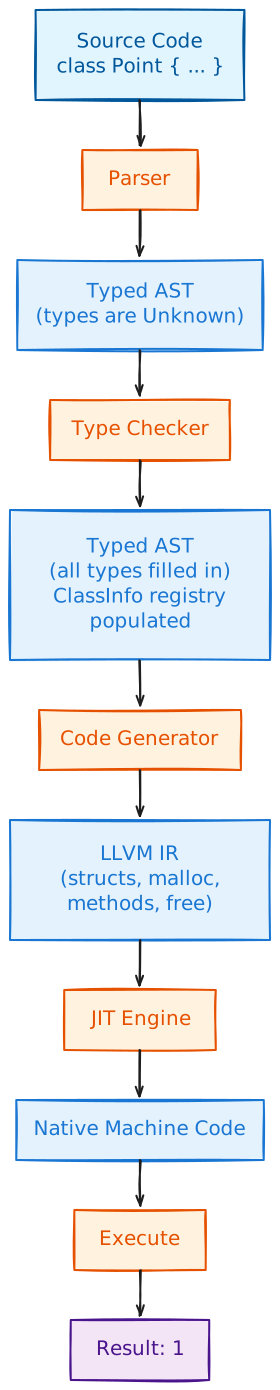
Each step transforms the program closer to executable code.
Running Point Example
Create a file examples/point.tl:
class Point {
    x: int
    y: int

    def __init__(self, x: int, y: int) {
        self.x = x
        self.y = y
    }

    def distance_squared(self, other: Point) -> int {
        dx = other.x - self.x
        dy = other.y - self.y
        return dx * dx + dy * dy
    }
}

p1 = new Point(0, 0)
p2 = new Point(3, 4)
p1.distance_squared(p2)
Run it:
cd thirdlang
rustup run nightly cargo run --bin thirdlang -- examples/point.tl
Output:
25
It works! We computed the distance squared from origin (0,0) to point (3,4), which is 3² + 4² = 25.
Running with Optimization
Thirdlang supports LLVM optimization passes. Compare unoptimized and optimized IR:
# Unoptimized IR (verbose, many allocas)
rustup run nightly cargo run --bin thirdlang -- --ir examples/point.tl

# Optimized IR (clean, efficient)
rustup run nightly cargo run --bin thirdlang -- --ir -O examples/point.tl
Run with optimization enabled:
# Default optimization (dce, mem2reg, instcombine, simplifycfg)
rustup run nightly cargo run --bin thirdlang -- -O examples/point.tl

# Custom pass pipeline
rustup run nightly cargo run --bin thirdlang -- --passes "mem2reg,dce" examples/point.tl

# LLVM's standard O2 optimization
rustup run nightly cargo run --bin thirdlang -- --passes "default<O2>" examples/point.tl
See Optimizing LLVM IR for details on how optimization works.
Running Counter Example
class Counter {
    value: int

    def __init__(self, start: int) {
        self.value = start
    }

    def increment(self) -> int {
        self.value = self.value + 1
        return self.value
    }

    def add(self, n: int) -> int {
        self.value = self.value + n
        return self.value
    }

    def get(self) -> int {
        return self.value
    }
}

c = new Counter(10)
c.increment()    # 11
c.increment()    # 12
c.increment()    # 13
c.add(5)         # 18
c.get()          # 18 - this is the return value
rustup run nightly cargo run --bin thirdlang -- examples/counter.tl
Output:
18
Running Destructor Example
class Resource {
    id: int
    status: int  # 1 = active, 0 = released

    def __init__(self, id: int) {
        self.id = id
        self.status = 1  # Mark as active
    }

    def is_active(self) -> bool {
        return self.status == 1
    }

    def __del__(self) {
        self.status = 0  # Mark as released
    }
}

r = new Resource(42)
active = r.is_active()   # true (1)
delete r                  # calls __del__, sets status = 0
active                    # returns 1 (from before delete)
rustup run nightly cargo run --bin thirdlang -- examples/destructor.tl
Output:
1
Running All Examples
cd thirdlang

# Point: distance calculation
rustup run nightly cargo run --bin thirdlang -- examples/point.tl

# Counter: stateful object
rustup run nightly cargo run --bin thirdlang -- examples/counter.tl

# Destructor: cleanup demo
rustup run nightly cargo run --bin thirdlang -- examples/destructor.tl

# Linked node: object references
rustup run nightly cargo run --bin thirdlang -- examples/linked_node.tl
Or run them all:
for file in examples/*.tl; do
    echo "=== $file ==="
    rustup run nightly cargo run --bin thirdlang -q -- "$file"
done
Running Tests
Thirdlang has tests covering all stages:
# Run all tests
rustup run nightly cargo test

# Run with output
rustup run nightly cargo test -- --nocapture

# Run specific test
rustup run nightly cargo test test_jit_point_distance
Test Categories
| Category | What It Tests |
|---|---|
| Parsing | Class syntax, methods, new/delete |
| Type checking | Class types, method signatures, field access |
| Code generation | LLVM struct creation, method compilation |
| JIT execution | Running compiled code, getting results |
Example test:
#[test]
fn test_jit_simple_class() {
    let source = r#"
        class Point {
            x: int
            def __init__(self, x: int) { self.x = x }
            def get_x(self) -> int { return self.x }
        }
        p = new Point(42)
        result = p.get_x()
        delete p
        result
    "#;
    assert_eq!(run(source).unwrap(), 42);
}
thirdlang/tests/integration_tests.rs
What We Built
Let us step back and appreciate what we accomplished:
Grammar (~124 lines)
- Class definitions with fields and methods
- Constructor and destructor syntax
newanddeleteexpressions- Field access and method calls
Type System (~200 lines)
Type::Class(name)variantClassInfowith fields and methods- Method type checking
- Object type inference
Parser (~540 lines)
- Parse classes, fields, methods
- Parse
new,delete,self - Parse field access, method calls
- Build typed AST
Type Checker (~640 lines)
- Class registration
- Method resolution
- Field type checking
- Constructor/destructor validation
Code Generator (~1050 lines)
- LLVM struct types for classes
- malloc/free integration
- Method compilation
- GEP for field access
- LLVM New Pass Manager for optimization
Total: ~2600 lines of Rust
All in a manageable codebase that implements real object-oriented features.
Comparing All Four Languages
| Feature | Calculator | Firstlang | Secondlang | Thirdlang |
|---|---|---|---|---|
| Grammar size | 18 lines | 70 lines | 77 lines | 124 lines |
| Type System | None | Dynamic | Static | Static + Classes |
| Variables | No | Yes | Yes | Yes |
| Functions | No | Yes | Yes | Yes + Methods |
| Classes | No | No | No | Yes |
| Memory | Stack | Stack | Stack | Stack + Heap |
| Execution | Interpreter/VM/JIT | Interpreter | LLVM JIT | LLVM JIT |
The progression is clear:
- Calculator - Learn basics: parsing, AST, evaluation
- Firstlang - Add programming: variables, functions, control flow
- Secondlang - Add types: static checking, compilation
- Thirdlang - Add OOP: classes, objects, memory management
What Next?
You now have a foundation for building real languages. Ideas to explore:
Language Features
- Inheritance - Virtual methods, vtables
- Interfaces/Traits - Polymorphism without inheritance
- Generics - Type parameters (
List<T>) - Closures - Functions capturing variables
- Pattern matching - Destructuring, exhaustive checks
Type System
- Nullability -
Point?vsPoint - Reference types - Distinguish owned vs borrowed
- Algebraic data types - Enums with data
Memory Management
- Garbage collection - Automatic memory
- Reference counting - Deterministic cleanup
- Ownership - Rust-style borrow checking
Code Generation
- AOT compilation - Compile to executables
- Optimizations - Inline methods, devirtualization
- Debug info - Source maps, breakpoints
What’s Next?
You have completed all four parts of the book. But this is just the beginning!
Continue to What’s Next: Your Journey Starts Here for:
- Ideas for extending Thirdlang (inheritance, generics, closures)
- New types to add (strings, arrays, algebraic data types)
- Different execution models (AOT compilation, bytecode VMs)
- Memory management approaches (GC, reference counting, ownership)
- Tooling (debuggers, formatters, language servers)
- Recommended reading and real languages to study
The concepts you learned - grammars, ASTs, type systems, code generation - apply to any language you might build or use.
Now go build something.