Optimizing LLVM IR
So far, our compiler generates correct but naive LLVM IR. Every variable gets a stack allocation (alloca), every parameter is stored and reloaded, and the code includes redundant operations. In this chapter, we integrate LLVM’s pass manager to optimize our IR before execution.
Prerequisites: This chapter assumes you understand LLVM IR syntax. If instructions like
alloca,load,store, andgetelementptrare unfamiliar, read From AST to IR first.
Requirement: This chapter requires LLVM 20+ because the
run_passes()API we use is part of LLVM’s New Pass Manager, which is fully supported in LLVM 20. Check your version withllvm-config --version.If you have a different LLVM version, update
thirdlang/Cargo.toml:# For LLVM 20.x inkwell = { version = "0.7", features = ["llvm20-1"] }
What Are Optimization Passes?
An optimization pass is a transformation that improves the IR without changing its behavior. LLVM provides dozens of passes that work together in a pipeline:
| Pass | What It Does |
|---|---|
mem2reg | Promotes stack allocations to SSA registers |
dce | Removes dead (unused) code |
instcombine | Combines redundant instructions |
simplifycfg | Simplifies control flow graph |
The Optimization Pipeline in Action
Let us trace how each pass transforms the IR for a simple increment method. This is the most important section to understand.
Step 0: Original Source
Create examples/counter.tl with a Counter class (or use the existing one):
class Counter {
    value: int

    def increment(self) -> int {
        self.value = self.value + 1
        return self.value
    }
}
Step 1: Unoptimized IR (what our codegen produces)
Generate with:
cd thirdlang
rustup run nightly cargo run -- --ir examples/counter.tl
Output (showing just the increment method):
define i64 @Counter__increment(ptr %self) {
entry:
  %self1 = alloca ptr, align 8              ; allocate stack slot for self
  store ptr %self, ptr %self1, align 8      ; store parameter to stack
  %self2 = load ptr, ptr %self1, align 8    ; load self from stack
  %field_ptr = getelementptr %Counter, ptr %self2, i32 0, i32 0
  %field = load i64, ptr %field_ptr         ; load self.value
  %add = add i64 %field, 1                  ; add 1
  %self3 = load ptr, ptr %self1, align 8    ; load self again!
  %field_ptr4 = getelementptr %Counter, ptr %self3, i32 0, i32 0
  store i64 %add, ptr %field_ptr4           ; store to self.value
  %self5 = load ptr, ptr %self1, align 8    ; load self a third time!
  %field_ptr6 = getelementptr %Counter, ptr %self5, i32 0, i32 0
  %field7 = load i64, ptr %field_ptr6       ; load self.value for return
  ret i64 %field7
}
Problems: 14 instructions, redundant loads, stack allocation for a parameter.
Step 2: After mem2reg
Generate with:
rustup run nightly cargo run -- --ir --passes "mem2reg" examples/counter.tl
The mem2reg pass promotes the alloca to an SSA register:
define i64 @Counter__increment(ptr %self) {
entry:
  ; No more alloca! %self is used directly
  %field_ptr = getelementptr %Counter, ptr %self, i32 0, i32 0
  %field = load i64, ptr %field_ptr
  %add = add i64 %field, 1
  %field_ptr4 = getelementptr %Counter, ptr %self, i32 0, i32 0
  store i64 %add, ptr %field_ptr4
  %field_ptr6 = getelementptr %Counter, ptr %self, i32 0, i32 0
  %field7 = load i64, ptr %field_ptr6
  ret i64 %field7
}
Result: Eliminated alloca, store, and 3 redundant loads of %self.
Step 3: After mem2reg,instcombine
Generate with:
rustup run nightly cargo run -- --ir --passes "mem2reg,instcombine" examples/counter.tl
The instcombine pass merges redundant GEP instructions and simplifies patterns:
define i64 @Counter__increment(ptr %self) {
entry:
  %field = load i64, ptr %self              ; GEPs merged, %self IS the field ptr
  %add = add i64 %field, 1
  store i64 %add, ptr %self
  %field7 = load i64, ptr %self             ; still loading for return
  ret i64 %field7
}
Result: Since Counter has only one field at offset 0, GEP simplifies away.
Step 4: After full pipeline (with dce)
Generate with:
rustup run nightly cargo run -- --ir -O examples/counter.tl
Or explicitly:
rustup run nightly cargo run -- --ir --passes "mem2reg,instcombine,dce,simplifycfg" examples/counter.tl
The dce pass removes the unnecessary final load - we already have the value in %add:
define i64 @Counter__increment(ptr %self) {
entry:
  %field = load i64, ptr %self, align 4
  %add = add i64 %field, 1
  store i64 %add, ptr %self, align 4
  ret i64 %add                              ; return %add directly!
}
Final Result: 4 instructions instead of 14!
Summary of the Pipeline
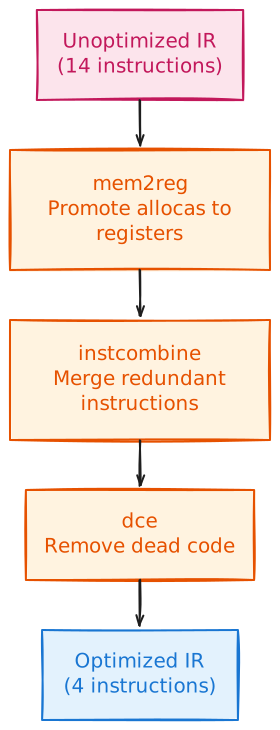
Implementation
The run_passes Method
Inkwell provides access to the pass manager through Module::run_passes():
    /// Run LLVM optimization passes using the New Pass Manager
    ///
    /// # Arguments
    /// * `passes` - A comma-separated list of passes, e.g., "dce,mem2reg,instcombine"
    ///   or a preset like "default<O2>"
    ///
    /// # Common passes for teaching:
    /// - `dce` - Dead Code Elimination
    /// - `mem2reg` - Promote allocas to SSA registers
    /// - `instcombine` - Combine redundant instructions
    /// - `simplifycfg` - Simplify control flow graph
    /// - `gvn` - Global Value Numbering
    /// - `default<O0>` through `default<O3>` - Standard optimization levels
    pub fn run_passes(&self, passes: &str) -> Result<(), String> {
        // Initialize native target for the current machine
        Target::initialize_native(&InitializationConfig::default())
            .map_err(|e| format!("Failed to initialize native target: {}", e))?;

        let triple = TargetMachine::get_default_triple();
        let target = Target::from_triple(&triple)
            .map_err(|e| format!("Failed to get target from triple: {}", e))?;

        let target_machine = target
            .create_target_machine(
                &triple,
                "generic", // CPU
                "",        // Features
                OptimizationLevel::Default,
                RelocMode::Default,
                CodeModel::Default,
            )
            .ok_or_else(|| "Failed to create target machine".to_string())?;

        let pass_options = PassBuilderOptions::create();
        pass_options.set_verify_each(true); // Verify IR after each pass

        self.module
            .run_passes(passes, &target_machine, pass_options)
            .map_err(|e| format!("Failed to run passes: {}", e))
    }
Key points:
- Initialize Native Target: Required before creating a TargetMachine
- Get Target Triple: The host machine description (e.g.,
x86_64-apple-darwin) - Create TargetMachine: Needed for target-specific optimizations
- run_passes: Takes a comma-separated list of passes
Pass Pipeline String
The passes argument is a string like:
"dce,mem2reg,instcombine"- Custom pipeline"default<O2>"- LLVM’s standard O2 optimization
Integration with JIT
We add an optional optimization step to our JIT runner:
/// JIT compile and run a program with optional optimization passes
///
/// # Arguments
/// * `program` - The parsed and type-checked program
/// * `classes` - Class registry from type checking
/// * `passes` - Optional optimization passes (e.g., "dce,mem2reg,instcombine")
pub fn jit_run_with_opts(
    program: &Program,
    classes: ClassRegistry,
    passes: Option<&str>,
) -> Result<i64, String> {
    let context = Context::create();
    let mut codegen = CodeGen::new(&context, "thirdlang", classes);

    codegen.compile(program)?;

    if let Some(pass_pipeline) = passes {
        codegen.run_passes(pass_pipeline)?;
    }

    let engine = codegen
        .module
        .create_jit_execution_engine(OptimizationLevel::Default)
        .map_err(|e| format!("Failed to create JIT: {}", e.to_string()))?;

    // Call the __main wrapper that holds the top-level statements.
    unsafe {
        let func: inkwell::execution_engine::JitFunction<unsafe extern "C" fn() -> i64> =
            engine.get_function("__main").map_err(|e| e.to_string())?;
        Ok(func.call())
    }
}
Understanding Each Pass
mem2reg: The Key Pass
mem2reg converts stack-allocated variables to SSA registers. This is critical because our codegen creates allocas for every variable, but registers are much faster than memory.
Before:
%x = alloca i64
store i64 42, ptr %x
%val = load i64, ptr %x
After:
%val = 42
dce: Dead Code Elimination
Removes instructions whose results are never used:
Before:
%unused = add i64 %a, %b    ; result never used
%result = mul i64 %c, %d
ret i64 %result
After:
%result = mul i64 %c, %d
ret i64 %result
instcombine: Instruction Combining
Simplifies patterns:
sub i64 %x, 1becomesadd i64 %x, -1mul i64 %x, 2becomesshl i64 %x, 1(shift left)- Constant folding:
add i64 3, 4becomes7
simplifycfg: Control Flow Simplification
Cleans up the control flow graph:
- Removes empty basic blocks
- Merges blocks with single predecessors
- Simplifies trivial branches
The counter.tl example has no branches, so simplifycfg has nothing to do there. To see it work, we need a method with control flow. Consider an abs method:
class Number {
    value: int

    def abs(self) -> int {
        if (self.value < 0) {
            return 0 - self.value
        } else {
            return self.value
        }
    }
}
After mem2reg, the abs method has three basic blocks and two separate ret instructions, one per branch:
define i64 @Number__abs(ptr %self) {
entry:
  %field_ptr = getelementptr %Number, ptr %self, i32 0, i32 0
  %field = load i64, ptr %field_ptr
  %lt = icmp slt i64 %field, 0
  br i1 %lt, label %then, label %else

then:
  %sub = sub i64 0, %field
  ret i64 %sub

else:
  ret i64 %field
}
Adding simplifycfg (--passes "mem2reg,simplifycfg") merges the two exits into a single return block. Because control can reach it from either branch, LLVM inserts a phi node to pick the right value based on which block executed:
define i64 @Number__abs(ptr %self) {
entry:
  %field_ptr = getelementptr %Number, ptr %self, i32 0, i32 0
  %field = load i64, ptr %field_ptr
  %lt = icmp slt i64 %field, 0
  br i1 %lt, label %then, label %else

common.ret:
  %common.ret.op = phi i64 [ %sub, %then ], [ %field, %else ]
  ret i64 %common.ret.op

then:
  %sub = sub i64 0, %field
  br label %common.ret

else:
  br label %common.ret
}
The phi node is how SSA form expresses “the value depends on the path taken”. Merging returns like this keeps the CFG small, which helps later passes and the backend generate tighter code.
Using the CLI
# Run without optimization
thirdlang examples/point.tl

# Run with optimization
thirdlang -O examples/point.tl

# Run with custom passes
thirdlang --passes "mem2reg,dce" examples/point.tl

# Print unoptimized IR
thirdlang --ir examples/point.tl

# Print optimized IR
thirdlang --ir -O examples/point.tl

# Use LLVM's O2 pipeline
thirdlang --passes "default<O2>" examples/point.tl
Testing Optimization
We verify that optimization produces correct results:
#[test]
fn test_optimization_pipeline() {
    use thirdlang::compile_to_ir_with_opts;

    let source = r#"
        class Simple {
            value: int

            def __init__(self, v: int) {
                self.value = v
            }

            def get(self) -> int {
                return self.value
            }
        }

        s = new Simple(100)
        result = s.get()
        delete s
        result
    "#;

    // Get unoptimized IR
    let unopt_ir = compile_to_ir_with_opts(source, None).unwrap();

    // Get optimized IR
    let opt_ir = compile_to_ir_with_opts(source, Some("mem2reg,dce,instcombine")).unwrap();

    // Optimized IR should be shorter (fewer alloca instructions)
    assert!(
        opt_ir.len() < unopt_ir.len(),
        "Optimized IR should be smaller"
    );

    // Unoptimized should have alloca for parameters
    assert!(
        unopt_ir.contains("alloca"),
        "Unoptimized IR should have allocas"
    );
}
Optimization Levels
LLVM provides preset pipelines:
| Level | Description |
|---|---|
default<O0> | No optimization (verification only) |
default<O1> | Light optimization |
default<O2> | Standard optimization (recommended) |
default<O3> | Aggressive optimization |
For teaching, we use dce,mem2reg,instcombine,simplifycfg to see each pass individually.
Summary
We added LLVM optimization:
- Created
run_passes()method that accepts a pipeline string - Integrated optimization into the JIT runner
- Added
-Oand--passesCLI flags
The key insight: our naive codegen produces correct but inefficient IR. LLVM passes transform it into efficient code:
mem2reg- Eliminates stack allocationsinstcombine- Merges redundant instructionsdce- Removes unused code
Try thirdlang --ir examples/counter.tl vs thirdlang --ir -O examples/counter.tl to see the difference!
Cross-References
- LLVM Code Generation - How we generate the initial IR
- From AST to IR - IR concepts from Secondlang