Constructors and Object Creation
This chapter assumes familiarity with function calls and type checking from previous parts.
When you write p = new Point(10, 20), several things happen:
- Memory is allocated on the heap
- The constructor (
__init__) is called - The object is initialized with the given values
- A pointer to the object is returned
Let us understand each step.
The __init__ Constructor
In Thirdlang (like Python), the constructor is named __init__:
class Point {
    x: int
    y: int

    def __init__(self, x: int, y: int) {
        self.x = x
        self.y = y
    }
}
The constructor:
- Always named
__init__ - First parameter is always
self - Has no explicit return type (implicitly returns nothing)
- Responsible for initializing all fields
Constructor Parameters
The constructor parameters (after self) become the arguments to new:
def __init__(self, x: int, y: int) { ... }
#                  ^^^^^^^^^^^^^ These become:
p = new Point(10, 20)
#             ^^^^^^ Constructor arguments
When you call new Point(10, 20):
selfis the newly allocated objectxis10yis20
Initializing Fields
Inside __init__, we use self.field = value to set fields:
def __init__(self, x: int, y: int) {
    self.x = x    # Set the 'x' field to parameter 'x'
    self.y = y    # Set the 'y' field to parameter 'y'
}
Fields must be initialized before the object can be used. Accessing an uninitialized field is undefined behavior (like uninitialized variables in C).
The new Expression
The new keyword creates objects:
p = new Point(10, 20)
This is an expression that:
- Allocates memory - Enough bytes for all fields
- Calls
__init__- Passing the new object asself - Returns a pointer - To the newly created object
How new Works
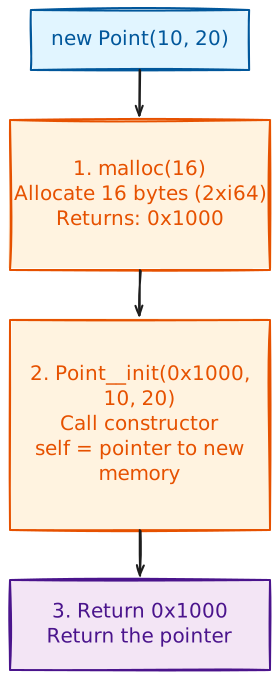
The result is a pointer to initialized memory.
Type Checking Constructors
The type checker verifies constructor calls:
/// Type check and infer types for a program
pub fn typecheck(program: &mut Program) -> Result<ClassRegistry, String> {
    let mut ctx = TypeContext::new();

    // First pass: register all classes
    for item in program.iter() {
        if let TopLevel::Class(class) = item {
            register_class(&mut ctx, class)?;
        }
    }

    // Second pass: collect function signatures
    for item in program.iter() {
        if let TopLevel::Stmt(Stmt::Function {
            name,
            params,
            return_type,
            ..
        }) = item
        {
            let param_types: Vec<Type> = params.iter().map(|(_, t)| t.clone()).collect();
            let func_type = Type::Function {
                params: param_types,
                ret: Box::new(return_type.clone()),
            };
            ctx.global_env.insert(name.clone(), func_type);
        }
    }

    // Third pass: type check classes
    for item in program.iter_mut() {
        if let TopLevel::Class(class) = item {
            typecheck_class(&mut ctx, class)?;
        }
    }

    // Fourth pass: type check statements
    // Use a persistent environment for top-level statements
    let mut top_level_env = ctx.global_env.clone();
    for item in program.iter_mut() {
        if let TopLevel::Stmt(stmt) = item {
            typecheck_stmt(&mut ctx, stmt, &mut top_level_env)?;
        }
    }

    Ok(ctx.classes)
}For new ClassName(args):
- Check class exists - Is there a class named
ClassName? - Check constructor exists - Does it have
__init__? - Check argument count - Right number of arguments (excluding
self)? - Check argument types - Do types match the constructor parameters?
- Return class type - The expression has type
Class("ClassName")
Example Type Check
class Point {
    x: int
    y: int
    def __init__(self, x: int, y: int) { ... }
}

p = new Point(10, 20)      # OK: 2 args match (int, int)
q = new Point(10)          # ERROR: expected 2 args, got 1
r = new Point(10, true)    # ERROR: expected int, got bool
Code Generation for new
Here is how we generate LLVM IR for object creation:
            Expr::New { class, args } => {
                // Get struct type and size
                let struct_type = self.class_types.get(class).ok_or("Class type not found")?;

                // Calculate size (number of fields * 8 bytes)
                let class_info = self.classes.get(class).ok_or("Class not found")?;
                let size = (class_info.size() * 8).max(8) as u64; // At least 8 bytes
                let size_val = self.context.i64_type().const_int(size, false);

                // Call malloc
                let malloc_fn = self.module.get_function("malloc").unwrap();
                let ptr = self
                    .builder
                    .build_call(malloc_fn, &[size_val.into()], "obj")
                    .unwrap()
                    .try_as_basic_value()
                    .unwrap_basic()
                    .into_pointer_value();

                // Initialize fields to zero
                for (i, _) in class_info.field_order.iter().enumerate() {
                    let field_ptr = self
                        .builder
                        .build_struct_gep(*struct_type, ptr, i as u32, "init_field")
                        .unwrap();
                    let zero = self.context.i64_type().const_int(0, false);
                    self.builder.build_store(field_ptr, zero).unwrap();
                }

                // Call constructor if exists
                let ctor_name = format!("{}____init__", class);
                if let Some(ctor) = self.functions.get(&ctor_name).cloned() {
                    let mut ctor_args: Vec<BasicMetadataValueEnum> = vec![ptr.into()];
                    for arg in args {
                        ctor_args.push(self.compile_expr(arg)?.into());
                    }
                    self.builder.build_call(ctor, &ctor_args, "").unwrap();
                }

                Ok(ptr.into())
}The generated LLVM IR looks like:
; new Point(10, 20)
%size = call i64 @llvm.sizeof.s_Point()
%raw = call ptr @malloc(i64 %size)
call void @Point____init__(ptr %raw, i64 10, i64 20)
; %raw is now a pointer to an initialized Point
Memory Layout
Objects are laid out in memory as LLVM structs:
class Point {
    x: int    # offset 0, 8 bytes
    y: int    # offset 8, 8 bytes
}             # total: 16 bytes
In LLVM IR:
%Point = type { i64, i64 }
;              ^^^  ^^^
;               x    y
Field order matters! We use field_order in ClassInfo to maintain consistent layout.
Constructors Without Parameters
Some classes have zero-parameter constructors:
class Counter {
    count: int

    def __init__(self) {
        self.count = 0
    }
}

c = new Counter()   # No arguments
The constructor still receives self, but no other arguments.
Multi-Field Initialization
For classes with many fields, the constructor initializes them all:
class Rectangle {
    x: int
    y: int
    width: int
    height: int

    def __init__(self, x: int, y: int, w: int, h: int) {
        self.x = x
        self.y = y
        self.width = w
        self.height = h
    }
}

r = new Rectangle(0, 0, 100, 50)
Each field gets initialized in the constructor body.
Common Patterns
Default Values in Constructor
class Config {
    value: int
    enabled: bool

    def __init__(self) {
        self.value = 42      # Default value
        self.enabled = true  # Default enabled
    }
}
Computed Initialization
class Square {
    side: int
    area: int

    def __init__(self, side: int) {
        self.side = side
        self.area = side * side  # Computed from input
    }
}
Validation (sort of)
Since we do not have exceptions, validation is limited:
class PositiveInt {
    value: int

    def __init__(self, v: int) {
        # Cannot truly validate, but can clamp
        if (v < 0) {
            self.value = 0
        } else {
            self.value = v
        }
    }
}
What About Failure?
Our constructors cannot fail. In real languages, constructors might:
- Throw exceptions (Java, Python)
- Return
ResultorOption(Rust) - Use factory methods instead
We keep things simple: constructors always succeed.
Summary
| Concept | Syntax | Purpose |
|---|---|---|
| Constructor | def __init__(self, ...) | Initialize new objects |
| Object creation | new ClassName(args) | Allocate and initialize |
| Field assignment | self.field = value | Set field values |
| Return type | Implicit Unit | Constructors don’t return values |
In the next chapter, we look at methods and the self parameter.