The Case for Types
Before we start adding types to our language, let us take a moment to understand why we would want types in the first place. After all, Firstlang works just fine without them.
Runtime Surprises
In Firstlang, we can write code like this:
def add(a, b) {
    return a + b
}

add(1, 2)      # works fine, returns 3
add(10, 20)    # works fine, returns 30
add(1, true)   # crashes at runtime!
The third call add(1, true) will crash when the program runs. But here is the problem: we do not know about this bug until we actually run the program and hit that specific line of code.
In a small program, this might be okay. But imagine a large program with thousands of lines. The buggy code might be in a rarely-used feature. You deploy your program, and months later, a user triggers that code path and the program crashes. Not good.
Catching Errors Early
With types, we tell the compiler what kind of values each variable can hold:
def add(a: int, b: int) -> int {
    return a + b
}

add(1, true)  # Error at COMPILE time: expected int, got bool
Now the compiler catches the bug before the program even runs. We know about the problem immediately, not months later in production.
Think of types as a contract. When we write a: int, we are promising that a will always be an integer. The compiler checks that we keep our promises.
Static vs Dynamic Typing
Programming languages are divided into two camps:
| Approach | When types are checked | Examples |
|---|---|---|
| Static typing | At compile time (before running) | Rust, C, Java, Haskell |
| Dynamic typing | At runtime (while running) | Python, JavaScript, Ruby |
Firstlang is dynamically typed. Secondlang is statically typed.
Both approaches have trade-offs:
- Static: Catches more bugs early, enables better performance, but requires more upfront type annotations
- Dynamic: More flexible, faster to prototype, but bugs can hide until runtime
Types Enable Fast Code
There is another benefit to types: performance.
Consider this function:
def square(x: int) -> int {
    return x * x
}
The compiler knows that x is always a 64-bit integer. It knows the result is always a 64-bit integer. So it can generate a single CPU instruction for the multiplication:
imul rax, rax ; multiply rax by itself
Without types, the interpreter has to do a lot of work at runtime:
- Check what type
xis - Look up the multiplication operation for that type
- Check if the operands are compatible
- Handle potential type errors
- Finally, do the multiplication
All this checking adds up. A statically typed language can be 10x to 100x faster than a dynamically typed one for number-crunching tasks.
This is why JIT compilers like V8 (JavaScript) and PyPy (Python) spend so much effort on type speculation - guessing what types values have so they can generate fast code.
Our Type System
We will keep things simple. Secondlang has two basic types:
| Type | What it holds | Examples |
|---|---|---|
int | 64-bit signed integer | 42, -1, 0 |
bool | Boolean value | true, false |
These are sometimes called primitive types.
Functions also have types. A function’s type describes what it takes in and what it produces:
def add(a: int, b: int) -> int { ... }
Type: (int, int) -> int
"Takes two ints, returns an int"

def isPositive(n: int) -> bool { ... }
Type: (int) -> bool
"Takes an int, returns a bool"
This notation (int, int) -> int is called a function type.
Type Inference Keeps Code Concise
You might worry that adding types means writing int everywhere, making code verbose. But we can be smarter.
Type inference means the compiler figures out types when it can:
def factorial(n: int) -> int {
    result = 1        # compiler infers: result is int
    i = 1             # compiler infers: i is int
    while (i <= n) {
        result = result * i
        i = i + 1
    }
    return result
}
We write the types on function parameters and return values (the boundaries), and the compiler infers the rest. This gives us the safety of types without excessive verbosity. We cover this in detail in the Type Inference chapter.
How Type Checking Works
Here is the high-level flow:
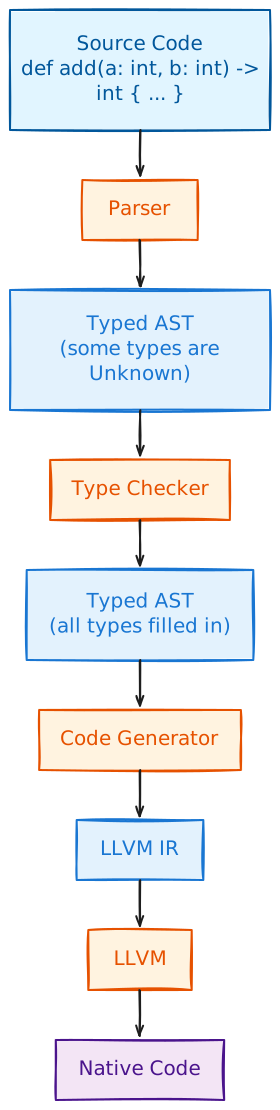
The parser creates an AST where some types are marked as Unknown (we do not know them yet). The type checker walks through the AST, figures out all the unknown types, and checks that everything is consistent. If something is wrong (like 1 + true), it reports an error. If everything is okay, we have a fully-typed AST ready for code generation.
Implementation
Our type system is defined in types.rs:
/// Types in our language
#[derive(Debug, Clone, PartialEq, Eq, Hash)]
pub enum Type {
    /// Integer type (64-bit signed)
    Int,
    /// Boolean type
    Bool,
    /// Function type: (param_types) -> return_type
    Function { params: Vec<Type>, ret: Box<Type> },
    /// Unit type (for statements with no value)
    Unit,
    /// Unknown type (for type inference)
    Unknown,
}Let us go through each variant:
Int- represents theinttype (64-bit signed integer)Bool- represents thebooltype (true/false)Function- represents a function type with parameter types and return typeUnit- represents “no value” (likevoidin C or()in Rust)Unknown- a placeholder used during type inference
The Unknown type is the key to type inference. When we parse x = 1 + 2, we do not know x’s type yet, so we mark it as Unknown. The type checker later figures out it must be Int (because 1 + 2 produces an Int).
Further Reading
- Type system on Wikipedia - overview of type system concepts
- Static vs Dynamic Typing - detailed comparison
- Strong and Weak Typing - another dimension of type systems
In the next chapter, we will see how to add type annotations to our grammar.