Computing Fibonacci
This is it - the culmination of everything we’ve built! Let’s compute the Fibonacci sequence.
The Fibonacci Sequence
The Fibonacci sequence starts with 0 and 1, and each subsequent number is the sum of the previous two:
0, 1, 1, 2, 3, 5, 8, 13, 21, 34, 55, ...
Mathematically:
$$ \text{fib}(n) = \begin{cases} 0 & \text{if } n = 0 \\ 1 & \text{if } n = 1 \\ \text{fib}(n-1) + \text{fib}(n-2) & \text{if } n > 1 \end{cases} $$
This sequence appears throughout nature - in flower petals, pine cones, and the spiral of shells. It is closely related to the golden ratio.
Recursive Implementation
The mathematical definition translates directly to code:
def fib(n) {
    if (n < 2) {
        return n
    } else {
        return fib(n - 1) + fib(n - 2)
    }
}

fib(10)  # = 55
This is simple, but let’s trace through what happens when we call fib(4):
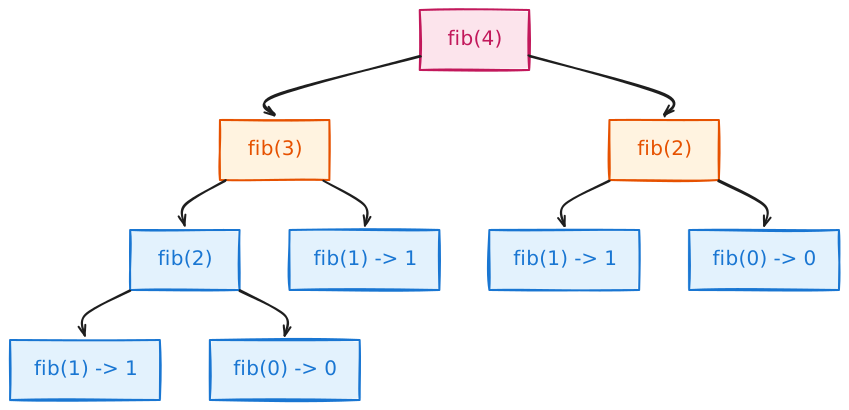
Each call creates a new stack frame in our interpreter, and when the function returns, we pop the frame and continue with the result.
How Our Interpreter Handles This
Our interpreter properly handles recursion because:
- Call Stack - Each function call pushes a new environment frame
- Local Variables - Parameters
nare local to each call - Return Values - We propagate return values up the call stack
Iterative Alternative
For comparison, here’s an iterative version (also works in Firstlang):
def fib_iter(n) {
    if (n < 2) {
        return n
    } else {
        a = 0
        b = 1
        i = 2
        while (i <= n) {
            temp = a + b
            a = b
            b = temp
            i = i + 1
        }
        return b
    }
}

fib_iter(10)  # = 55
The iterative version is more efficient ($O(n)$ vs $O(2^n)$ - see Big O notation), but the recursive version is cleaner and shows what our language can do.
Running It
Save to examples/fibonacci.fl and run:
cargo run -- examples/fibonacci.fl
55
Or in the REPL:
>>> def fib(n) {
...     if (n < 2) { return n } else { return fib(n - 1) + fib(n - 2) }
... }
>>> fib(10)
55
>>> fib(20)
6765
Performance Note
Our tree-walking interpreter is not optimized. Computing fib(35) might take several seconds due to exponential complexity and interpretation overhead.
In the next part of the book (Secondlang), we’ll add types and compile to native code via LLVM - making fib(35) nearly instant!
What We’ve Built
Congratulations! You’ve built a complete interpreted programming language that can:
- Parse Python-like syntax
- Handle variables and scoping
- Define and call functions
- Support recursion with proper stack frames
- Execute control flow (if/else, while)
- Compute Fibonacci recursively
The Firstlang interpreter is about 500 lines of Rust - not bad for a real programming language!
Next Steps
Ready for more? In Part III: Secondlang, we’ll add:
- Type annotations (
def fib(n: int) -> int) - Type inference
- LLVM code generation
- JIT compilation to native code
The same Fibonacci function, but compiled to machine code!